The Tour de France is a week too long
Fourteen days of July
Somewhere in the third week of this year's Tour de France, I noticed something that slightly horrified me: I'd stopped watching.
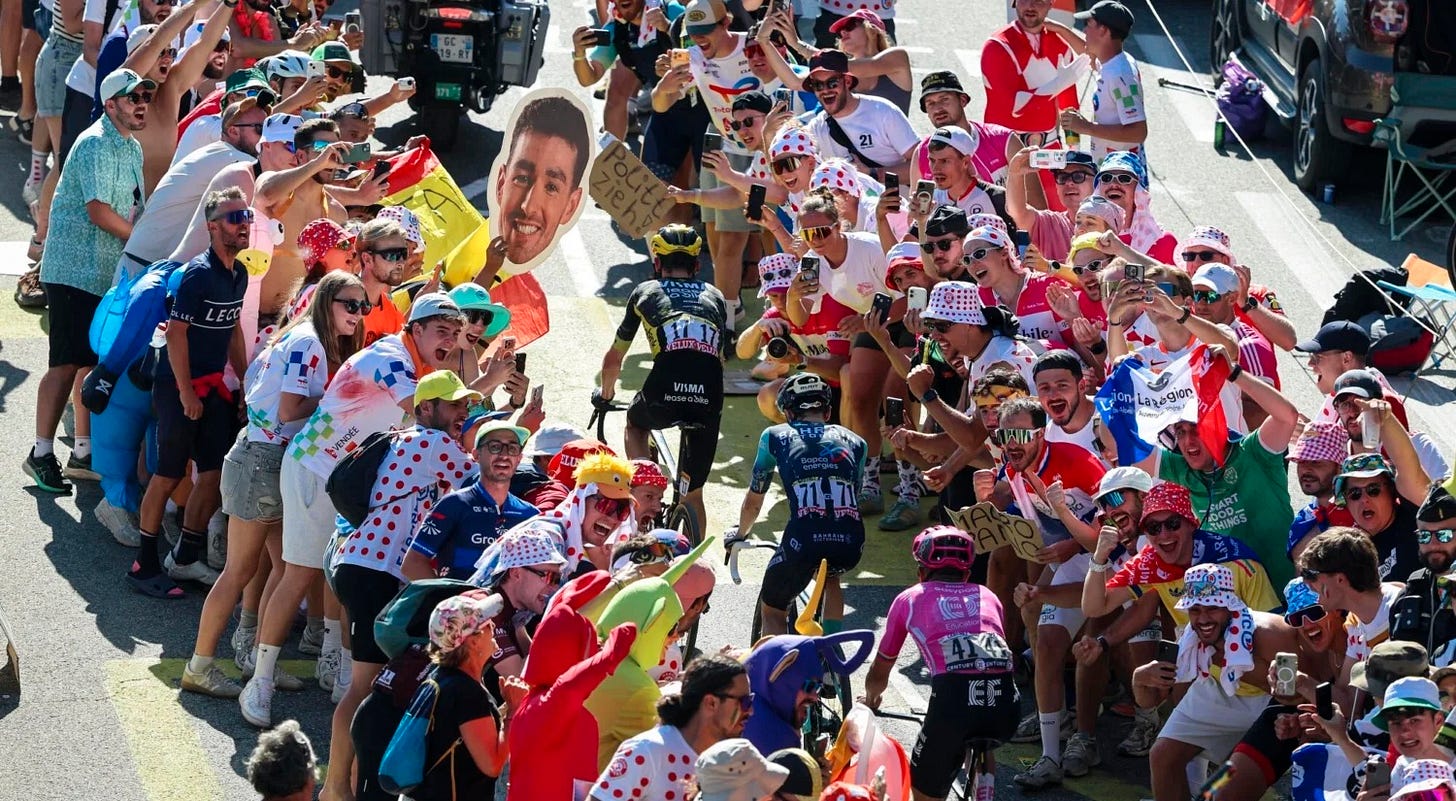
Not officially. Officially the race was on, the way it's on every July afternoon of my adult life. But I was half there. Checking the phone. Wandering off to make coffee during stages I would once have inhaled. I've built a fair chunk of my life around this sport, I write about it, I plan holidays around cols because the Tour went up them once, and even I had drifted. And when the credits rolled in Paris I didn't feel the usual post-Tour emptiness. I felt something closer to relief, which is a strange thing to feel about the race you love most.
Then, after a week's pause, the Tour de France Femmes started, nine days of it, and it was brilliant. Then a few weeks after that, the Vuelta. Somewhere in there I realised the problem isn't me, and it isn't the racing. It's the portion size.
So here's my heresy for the week, and I'd ask you to at least finish the piece before writing your angry comment: the Tour de France should be two weeks long.
I know. Breathe.
Let me make the case, because I think it's stronger than it sounds, and it starts with an honest look at what those 21 stages actually contain. Be truthful with yourself: how many stages of this year's Tour do you remember? Not vaguely, actually remember. I'd wager it's six, maybe eight. The rest were connective tissue. Transition stages across the middle of France that exist because the geography demands crossing, sprint stages that are 190 kilometres of nothing arranged around 90 seconds of something, the ceremonial processions. We've normalised the idea that a fan should donate 21 afternoons of July to this, plus another chunk of August, and anyone who drifts must not be a real fan. Maybe. Or maybe the format was designed for a world where the Tour was the only thing on, and we now live in a different one.
Now imagine the fourteen-day version, because the moment you shrink the container, everything in it has to justify its place. No room for three interchangeable sprint days, so you keep the two best and make them count. The mountains can't all be piled into a decisive final week, so the climbing gets spread and the GC race starts on day three instead of day ten. Gravel, crosswinds, a proper hilly classics day, a time trial that matters: when every stage is load-bearing, the course becomes a curated thing rather than a geographic obligation. The organisers half know this already. It's why they keep bolting gimmicks onto week one, because they too can feel the dead air.
Think about the riders. Three weeks is an attrition contest as much as a bike race, and I understand that's partly the romance, but look at what it actually produces: half the peloton riding the final week hollow-eyed and sick, abandons thinning the race just as it should be crescendoing, and stars forced to choose between Grand Tours like they're choosing which child to attend graduation. A two-week Tour means fresher racing at the sharp end, fewer bodies broken for the sake of tradition, and suddenly the Tour-Vuelta double stops being an act of self-harm and becomes a season narrative. More of the best riders doing more of the biggest races. Explain to me how that's bad for the sport.
And then there's the part I care about most, which is what you do with the space you've freed. Because I'm not really arguing for less bike racing in the summer. I'm arguing for redistributing it. Give the women's Tour twelve days. Give it rest days, plural, which sounds like a small administrative thing until you remember the biggest race in women's cycling currently sprints from start to finish without one. Give it more than a single queen mountain stage, because this year proved, on Ventoux of all places, that the racing at altitude is the best product women's cycling has, and we ration it like it's wartime. The gap between a fourteen-day men's race and a twelve-day women's race is nearly nothing. At that point they're not the main event and the support act. They're two halves of the same July.
None of which is to pretend the women's race isn't already growing well. It is, deliberately, year on year, and the people running it have been smarter than most give them credit for. I'm just saying the ceiling shouldn't be "nine days and one volcano."
Now, the objections, because I can hear them from here. Tradition: the Tour has been three weeks for over a century, and a two-week race isn't a Grand Tour, it's something else. Fair, but be careful which traditions you're defending. The Tour used to make riders fix their own forks and ride through the night; length has changed plenty of times before the current shape calcified. The epic argument: three weeks reveals the strongest in a way two cannot. Also fair, and also the best counterargument, though I'd gently note that the strongest man has usually been identifiable by the second Saturday for years now, and the third week mostly confirms the maths. And the money: host towns, broadcast hours, ASO's golden goose. True, and it's the real reason none of this will happen. But "the format exists to sell more format" is an explanation, not a defence.
Here's the test I keep coming back to. Nobody's favourite Tour memory is its length. It's a moment. A single attack, a single collapse, a single afternoon. The length is just the packaging the moments come in, and the packaging has quietly become the product. Fourteen days with nothing wasted against twenty-one with a third of it filler: I know which race I'd watch every minute of. I miss watching every minute. That used to be the whole point of July.
The Tour will never do it, of course. But that's what a Substack is for.
See you in the comments. Bring your pitchforks, I'll make coffee.